Standing all day loads the same tissues without a break: the plantar fascia and heel pad under your arch, and the calf muscles that pump blood back up your legs. Pain usually builds late in the shift and bites hardest on the first steps the next morning. Support under the arch for the whole shift is what changes the load.
Alex Moreno is a gear reviewer, not a doctor, podiatrist or physiotherapist. This guide describes products and published research. It is not a diagnosis of your feet.
Affiliate disclosure: some links below are affiliate links. If you buy through them, Lume-Trixa may earn a commission at no extra cost to you. It does not change what this guide says or which studies it cites.
Why do my feet hurt more at the end of the shift?
Because standing is a load your foot never gets a break from. Walking spreads the work around: each step loads a different part of the foot, then unloads it a moment later. Standing on a hard floor for hours keeps the same structures under pressure the entire time, and there is no unloaded moment for them to recover in.
Two things are carrying that pressure. The first is the plantar fascia, a thick band of tissue that runs from your heel to the base of your toes and works like the string of a bow, holding the arch in shape every time weight comes down on it. The second is the fat pad under your heel, which is the built-in cushion between the heel bone and the floor. Both handle a normal day fine. Both feel very different at hour seven on tile or concrete.
Your calves are the other half of the story. The calf muscles squeeze the deep veins in your legs and push blood back up towards the heart, which is why they get called a muscle pump. When you walk, that pump runs constantly. When you stand still behind a counter or at a workstation, it barely runs at all, fluid settles in your lower legs, and by the evening your legs feel heavy and your shoes feel tighter than they did in the morning. That is why standing still is often harder on people than a job that keeps them moving.
Why does it hurt most on the first steps in the morning?
Because the tissue tightens up overnight while it is unloaded, then gets loaded all at once when you put your foot down. Those first few steps stretch it back out, which is why the pain is sharp for a moment and then eases as you move around. The American Academy of Orthopaedic Surgeons describes exactly this pattern for plantar fasciitis: pain that is worst with the first steps after getting out of bed or after a long period of rest.
You will notice the same thing on a smaller scale during the day. Sit down for a twenty minute break, stand back up, and the first dozen steps hurt more than the last hour did. That morning and after-rest pattern is one of the most useful things you can notice about your own feet, and it goes into the self-check further down this page.
Already know your shoes have nothing under the arch?
That is the most common version of this problem, and it is the one an insole is actually built for. We bought a pair of Akusoli acupressure insoles, wore them through full days on hard floors and wrote up what changed and what did not.
See the current price and the guarantee on the official storePrefer the long version first? Read our full Akusoli insoles review, with the sizing, the returns terms and what the trials on insoles found.
Is foot pain from standing all day common, or is it just me?
It is common enough to show up in national health statistics. Riddle and Schappert, writing in Foot & Ankle International in 2004, pulled six years of United States National Ambulatory Medical Care Survey data and estimated approximately one million patient visits a year to office-based physicians and hospital outpatient departments for the diagnosis and treatment of plantar fasciitis alone. Around 62 percent of those visits went to primary care practitioners and 31 percent to orthopaedic surgeons.
That is only the people who booked an appointment for one specific diagnosis. It does not count everyone who limps to the sofa after a shift and never mentions it to anyone.
On the work side, Waters and Dick reviewed the evidence on prolonged standing at work for Rehabilitation Nursing in 2015, writing from the National Institute for Occupational Safety and Health. Their review found ample evidence that prolonged standing at work is associated with adverse outcomes including lower back and leg pain, fatigue and discomfort. It also listed the interventions that helped, and the list is short and practical: floor mats, sit-stand workstations and chairs, shoes, shoe inserts, and support hosiery.
Worth sitting with that last point for a second. A federal occupational health review, looking at what actually reduces the harm of standing all day, named what goes under your feet as one of the things that works.
How do I work out what kind of foot pain I have?
Run this four-point self-check and write the answers in your phone. It takes two minutes, it gives you a baseline you can compare against in six weeks, and it is far more useful than a vague memory of "my feet hurt".
- 1. Where exactly does it hurt?Point at it with one finger. Heel, arch, the ball of the foot behind the toes, or a general ache that includes your calves and shins. Pick the single worst spot rather than saying "everywhere".
- 2. When in the day does it hurt?First steps in the morning, building through the shift, or hitting hardest in the evening once you finally sit down. Note whether it is worse at the end of the week than at the start.
- 3. How long does it take to settle when you sit?A few minutes, most of an hour, or still there when you wake up. This is the single best measure of whether things are improving later on.
- 4. What makes it better and what makes it worse?Better: sitting, a different pair of shoes, moving around, a softer floor. Worse: barefoot on tile, standing still, thin flat soles, a double shift. Small details here tell you more than the pain score does.
What the answers usually mean, and this is a pattern rather than a diagnosis. Heel pain that is sharpest on the first steps in the morning is the pattern people most often describe with plantar heel pain. Pain across the ball of the foot that builds through the shift is the pattern people describe when load sits on the forefoot for hours, often in thin or stiff-soled work shoes. A heavy, aching, swollen-feeling lower leg by the evening is the standing-still-and-circulation pattern rather than a foot-structure one.
If you have diabetes, reduced feeling in your feet, new one-sided swelling, or a sore that will not heal, see a clinician before relying on an insole or a massager, because those need a proper look. The same goes for pain that keeps getting worse week after week instead of tracking with how much you stood.
Do stretching and rolling a bottle actually fix it?
They help, they are free, and you should do them. What they cannot do is compete with the hours. A calf stretch and a few minutes rolling your arch over a cold bottle treat the tissue for maybe five to ten minutes a day. Your shift loads it for eight hours. Those are not the same size of problem, and they are not alternatives to each other.
The honest way to think about it is that stretching and rolling change how the tissue recovers, and what is under your foot changes how much it has to recover from. One is minutes of treatment. The other is the whole workday. People who get the best result out of this usually do both, and the mistake is treating one as a replacement for the other.
What actually takes the load off during the eight hours?
Spreading the load across more of the foot for the whole time you are standing. Instead of the heel and the ball of the foot taking almost everything while the arch sits in mid-air over a flat factory insole, a shaped insert fills that gap so more of the foot surface is carrying the weight. It is a simple mechanical idea, and it runs for the entire shift without you thinking about it.
There is real trial evidence behind the category. Whittaker, Munteanu, Menz and colleagues published a systematic review and meta-analysis in the British Journal of Sports Medicine in 2018, pooling 19 randomised trials with 1,660 participants. In the medium term, defined as 7 to 12 weeks, there was moderate-quality evidence that foot orthoses reduced pain more than sham insoles. In the short term, 0 to 6 weeks, and in the longer term, the evidence was very low quality. The review also found no difference between customised and prefabricated orthoses at any time point.
Two things to be clear about. Those trials tested the category, foot orthoses in general, not any particular brand on sale today, so nothing there is evidence about a specific product. And the timeline is the part most people get wrong: the benefit showed up in the medium term, which means a two-week verdict is too early. We wrote a whole guide on how long insoles take to work and how to judge a pair fairly, because that expectation gap is where most people give up.
What to look for in a pair, if you are standing all day
- Full length, not a half insert. You are covering a shift, not a workout, and the forefoot is doing a lot of the suffering.
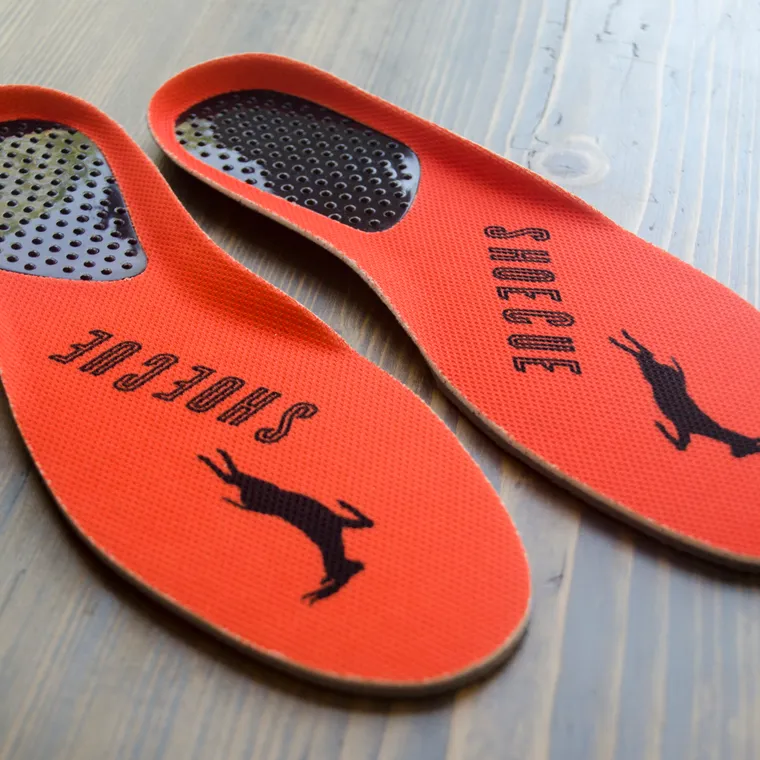
- A defined arch shape that you can feel when you first stand on it. Flat foam compresses to nothing after a few weeks of eight-hour days.
- It has to fit your actual work shoe. If it lifts your heel out of the back of the shoe, it will not last a week, so check whether the original factory insole comes out first.
- A seller with a stated returns window. Given the 7 to 12 week timeline above, a written guarantee is not a nice extra, it is what makes a fair trial possible.
What helps at the end of the shift, once you are off your feet?
The end of the day is a comfort problem rather than a load problem, and it deserves its own answer. Once you sit down, nothing more is being loaded. What people are chasing at that point is the feeling of aching, tight, heavy feet easing off before bed.
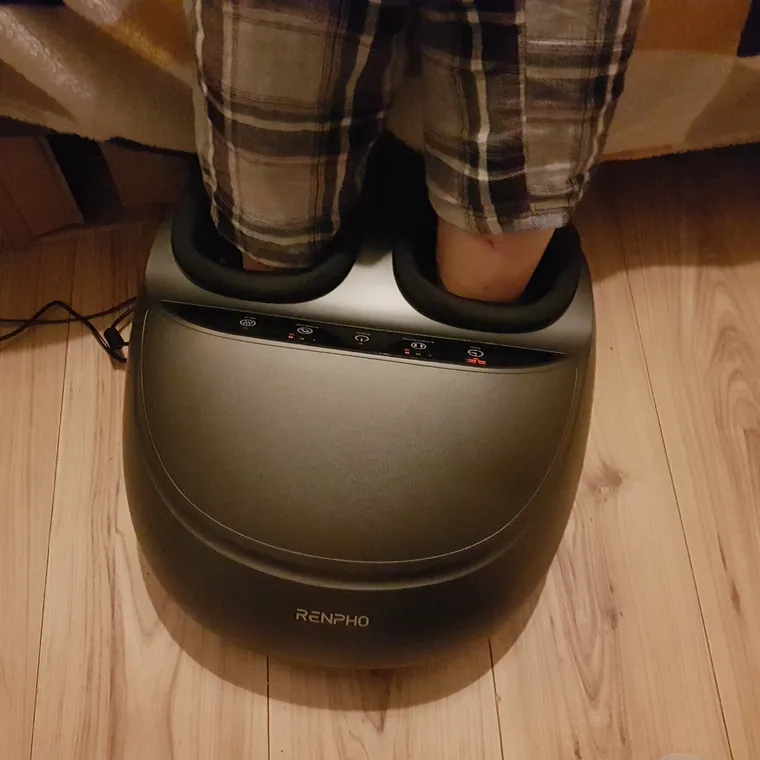
Getting your feet up, a warm soak, and a few minutes of pressure through the arch all belong here. So do the cordless foot massagers that pair warmth with compression and vibration, which is the category we looked at when we bought and tested the EMSense triple therapy foot massager, including how the warmth and compression modes actually feel. Treat it as what it is: something pleasant that helps you wind down, not a treatment and not a replacement for what happens during the shift. The official EMSense store lists the current price and the return terms if you want to compare it against a basic soak.
So what would we do first?
In this order, because it goes cheapest and highest-yield first. Run the four-point self-check tonight and write it down. Take the flat factory insole out of your work shoes and see what is actually under your arch, which for most work shoes is nothing at all. Put a properly shaped full-length insole in, wear it every shift rather than on and off, and keep the stretching and the end-of-day routine going alongside it. Then reassess against your written baseline at six weeks and again at twelve, not at day ten.
If your feet are worse at twelve weeks despite all of that, or if anything on the safety list above applies to you, that is the point to get it looked at properly. An insole is a load-spreading device, not a substitute for having a persistent problem examined.
The pair we tested for eight-hour days
Akusoli is a full-length acupressure and support insole aimed squarely at people who stand for a living. Our review covers the fit in work shoes, the textured surface, the returns terms, and what the published research on insoles does and does not say.
See the current price and the guarantee on the official storeOr read the full Akusoli insoles review with our score and the fit notes first.
Frequently asked questions
How long does foot pain from standing all day take to settle?
Day-to-day soreness usually eases overnight. A pattern that has built up over months does not, and the trial data on insoles is a good guide to the timescale: in the Whittaker 2018 meta-analysis, foot orthoses beat sham insoles at 7 to 12 weeks rather than in the first six. Judge any change you make against a written baseline at six and twelve weeks.
Do insoles help if my work shoes are already comfortable?
Often yes, because comfortable and supportive are different things. Most shoes ship with a flat foam liner that compresses and leaves the arch unsupported. Pull that liner out and look at it. If it is thin and flat, a shaped full-length insole changes what your foot is standing on for the whole shift, which the shoe on its own was never doing.
Should I skip insoles and get custom orthotics instead?
Not as a first step for most people. The Whittaker 2018 meta-analysis found no difference between customised and prefabricated foot orthoses at any follow-up point. Custom work earns its price when a clinician identifies a structural reason for it. We compare both routes in our guide on custom orthotics versus off-the-shelf insoles.
Does a foot massager fix the pain, or just feel nice?
Treat it as comfort. Warmth, compression and vibration feel good on tired feet at the end of a shift and help you wind down, and that is a real benefit worth paying for if you value it. It is not doing anything about the eight hours of load that caused the ache, which is the job of what sits inside your shoe.
Is standing all day at work bad for you?
Waters and Dick, reviewing the literature for Rehabilitation Nursing in 2015 from the National Institute for Occupational Safety and Health, found ample evidence that prolonged standing at work is associated with adverse outcomes including lower back and leg pain, fatigue and discomfort. The same review listed floor mats, sit-stand workstations, shoes, shoe inserts and support hosiery among the interventions that reduce the hazard.
Sources
- Whittaker GA, Munteanu SE, Menz HB, Tan JM, Rabusin CL, Landorf KB. "Foot orthoses for plantar heel pain: a systematic review and meta-analysis." British Journal of Sports Medicine, 2018;52(5):322-328. pubmed.ncbi.nlm.nih.gov/28935689
- Riddle DL, Schappert SM. "Volume of ambulatory care visits and patterns of care for patients diagnosed with plantar fasciitis: a national study of medical doctors." Foot & Ankle International, 2004;25(5):303-310. pubmed.ncbi.nlm.nih.gov/15134610
- Waters TR, Dick RB. "Evidence of health risks associated with prolonged standing at work and intervention effectiveness." Rehabilitation Nursing, 2015;40(3):148-165. pubmed.ncbi.nlm.nih.gov/25041875
- American Academy of Orthopaedic Surgeons, OrthoInfo. "Plantar Fasciitis and Bone Spurs." orthoinfo.org
Image credits: hospital corridor and sore foot photographs via Pexels. Insole photographs via Wikimedia Commons: Ak12121234 (CC BY-SA 4.0) and "Best For My Feet" (CC BY-SA 3.0).

About the author
Alex Moreno writes the everyday-gear guides at Lume-Trixa. He buys the products with his own money, uses them for weeks rather than an afternoon, then reads the published research behind the idea. He is not a doctor, podiatrist or physiotherapist, and every foot and leg guide he writes says so.
More about Alex Moreno ›Keep reading
- How long do insoles take to work? The realistic window, why the first two weeks feel like nothing, and how to judge a pair before the returns period runs out.
- Custom orthotics vs insoles: which is worth your money? What the head-to-head trials found, and when a moulded prescription pair is genuinely worth the extra.
Affiliate disclosure: some links on this page are affiliate links. If you buy through them we may earn a commission, at no additional cost to you. This does not affect our editorial assessment or the scores we publish. Content in this guide is general information about products and published research, not medical advice, and it is not a substitute for having a persistent problem examined by a clinician.