Give a new pair a full twelve weeks before you judge them. In the meta-analysis by Whittaker and colleagues, foot orthoses only beat sham insoles at the seven to twelve week mark, not in the first six weeks. The first two weeks are adaptation, and they often feel like nothing at all.
Alex Moreno is a gear reviewer, not a doctor, podiatrist or physiotherapist. This guide describes products and published research. It is not a diagnosis of your feet.
Affiliate disclosure: some links below are affiliate links. If you buy through them, Lume-Trixa may earn a commission at no extra cost to you. It does not change what this guide says or which studies it cites.
How long before insoles actually feel like they are working?
The realistic window is around seven to twelve weeks of daily wear, and the best evidence we have points at the back half of that.
Whittaker, Munteanu, Menz and colleagues published a systematic review and meta-analysis of foot orthoses for plantar heel pain in the British Journal of Sports Medicine in 2018. They pooled 19 randomised trials with 1,660 participants and split the results by how long the follow-up ran: short term was 0 to 6 weeks, medium term was 7 to 12 weeks, and longer term was 13 to 52 weeks.
What came out of it is the single most useful fact for anyone who has just bought a pair. In the medium term there was moderate-quality evidence that foot orthoses reduced pain more than sham insoles. In the short term and in the longer term the evidence was very low quality, which means the trials at those points were too few and too inconsistent to tell you much either way.
Read that back and the practical instruction is obvious. Two weeks is inside the window where even well-run trials found nothing clear. Judging your pair at two weeks is not a verdict, it is checking the oven ten minutes into a roast.
One thing to be straight about: those trials tested the category, foot orthoses in general, against sham insoles. They are not evidence about any particular brand you can buy today, and no brand gets to claim them as its own result.
Why do the first two weeks often feel like nothing?
Because the first fortnight is mostly adaptation, and adaptation is not a comfortable process for everyone.
You have changed the shape of the surface your foot has stood on for years. The arch is now supported where it used to drop, so slightly different muscles are working, and your foot, ankle and calf spend a couple of weeks settling into it. Some people feel an ache in the arch or a bit of soreness in a new place for the first few days. That is common, and easing into it by wearing the pair for part of a shift on days one to three usually smooths it out.
Two other things quietly ruin the first month. The first is intermittent use: a pair worn on Monday and Thursday, in one of three pairs of shoes, is not being given a real test at all. The second is judging by memory. If you have no written record of how bad week zero was, a modest improvement at week six feels like nothing, because your memory quietly resets to how you feel today.
Starting the twelve-week clock on a pair worth testing
Akusoli is a full-length acupressure and support insole aimed at people who stand all day. Our review covers the fit in work shoes, the textured surface, and the terms you get if you decide it is not for you.
See the current price and the guarantee on the official storeOr read our full Akusoli insoles review, with the sizing notes and what the research on insoles does and does not say.
What improves first, and what takes longest?
In the order people usually report it, the first change is how the shift ends, and the last change is the sharp morning pain.
- Days 1 to 14, the feel underfoot. Standing feels less like balancing on a plank. This is not a result yet, it is just the new surface, but it tells you the fit is right.
- Weeks 2 to 6, end-of-shift fatigue. The heavy, done-in feeling at hour seven is usually the first thing to shift, and it is easy to miss because it improves by degrees rather than switching off.
- Weeks 6 to 12, the first steps in the morning. The sharp pain on the first steps out of bed is the slowest to change, and it is the one that matters most to people who have it. This is the band the trial evidence points at.
Progress is also uneven rather than a smooth line. A double shift or a run of long days will produce a bad week in the middle of a good month. That is why you compare week six against week zero, not against last Tuesday.
How do I measure whether they are actually working?
Write down a baseline before you start, then re-check the same four things at two, six and twelve weeks. It takes two minutes and it is the difference between an answer and a shrug.
- Where it hurtsHeel, arch, the ball of the foot, or a general ache including the calves. One finger, one spot.
- When it hurtsFirst steps in the morning, building through the shift, or worst in the evening once you sit down.
- How long it takes to settleMinutes, most of an hour, or still there the next morning. This is the number that moves first and most.
- What makes it better and worseWhich floors, which shoes, which length of shift. Note anything that changed in the same period, like a new job or a heavier week.
This is the same four-point self-check from our guide on why your feet hurt after standing all day, where there is more on what each pattern usually means. Take a photo of the note on day one so you cannot rewrite history later.
Does the returns window cover a fair trial?
Check the stated window on the official store before you buy, then plan the trial around it instead of hoping. A guarantee is only useful if you actually use the whole thing.
Three habits make the window work in your favour. Start wearing the pair daily the day it arrives, so the trial period and the guarantee period run together rather than the pair sitting in a drawer for three weeks. Keep the packaging until you have decided. And put two reminders in your phone, at week six and at a few days before the window closes, so the decision gets made by you rather than by a date passing.
If the window is shorter than the twelve weeks the trials point at, you can still make a sound call inside it: use the six-week check on end-of-shift fatigue and on how fast the ache settles when you sit. Those move earlier than the morning pain does, and they are enough to tell whether a pair is heading in the right direction.
What if twelve weeks pass and nothing has changed?
Then you have a real answer, which is worth more than another month of guessing. Before you write the pair off, check the three things that account for most of the disappointing trials we hear about: the original factory liner was still in the shoe underneath, the pair was worn on some days and not others, or it went into a shoe that was already too tight, so the foot spent the shift being squeezed rather than supported.
If none of those apply and the honest verdict is no change, use the guarantee. And take the result seriously as information: persistent foot pain that has not budged in three months is worth having examined rather than solved by buying a fourth pair of something. An insole is a load-spreading device, not a substitute for having it looked at.
If you have diabetes, reduced feeling in your feet, new one-sided swelling, or a sore that will not heal, see a clinician before relying on an insole or a massager, because those need a proper look.
The pair we ran the twelve-week clock on
Full-length, shaped, and built for people who stand for a living. Our review has the fit notes, the textured surface, the returns terms and our score.
See the current price and the guarantee on the official storeRead the full Akusoli insoles review first if you want the long version.
Frequently asked questions
Should insoles hurt at first?
Mild new-shape soreness in the arch during the first few days is common while your foot adapts, and it usually settles if you wear the pair for part of a shift for the first two or three days before going all day. Sharp pain, rubbing that breaks the skin, or pain that is worse in week three than in week one is a sign of a fit problem rather than an adaptation phase.
How many hours a day should I wear them?
Ease in over the first two or three days, then wear them for the whole time you are on your feet. Consistency is what makes the twelve-week window mean anything: a pair worn on two days out of five is not being tested, and that is the most common reason a month passes with no verdict either way.
Do insoles wear out, and how would I know?
Yes. The signal is that the arch stops feeling like it is there and your end-of-shift fatigue creeps back to where it was, which is exactly why the written baseline is useful. Look at the pair as well: visible flattening under the arch or a compressed heel area means it is no longer doing the mechanical job it was doing at the start.
Would custom orthotics work faster than off-the-shelf insoles?
The Whittaker 2018 meta-analysis compared customised with prefabricated foot orthoses and found no difference at any time point, so there is no evidence in that data for a faster result from the expensive route. We go through both options in our guide on custom orthotics versus off-the-shelf insoles.
Sources
- Whittaker GA, Munteanu SE, Menz HB, Tan JM, Rabusin CL, Landorf KB. "Foot orthoses for plantar heel pain: a systematic review and meta-analysis." British Journal of Sports Medicine, 2018;52(5):322-328. pubmed.ncbi.nlm.nih.gov/28935689
- Waters TR, Dick RB. "Evidence of health risks associated with prolonged standing at work and intervention effectiveness." Rehabilitation Nursing, 2015;40(3):148-165. pubmed.ncbi.nlm.nih.gov/25041875
- American Academy of Orthopaedic Surgeons, OrthoInfo. "Plantar Fasciitis and Bone Spurs." orthoinfo.org
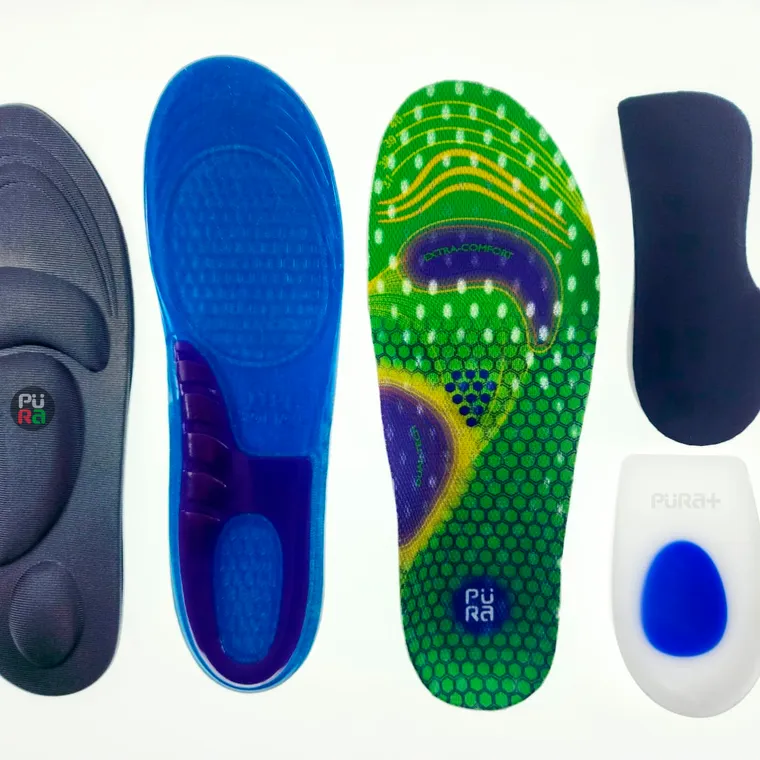
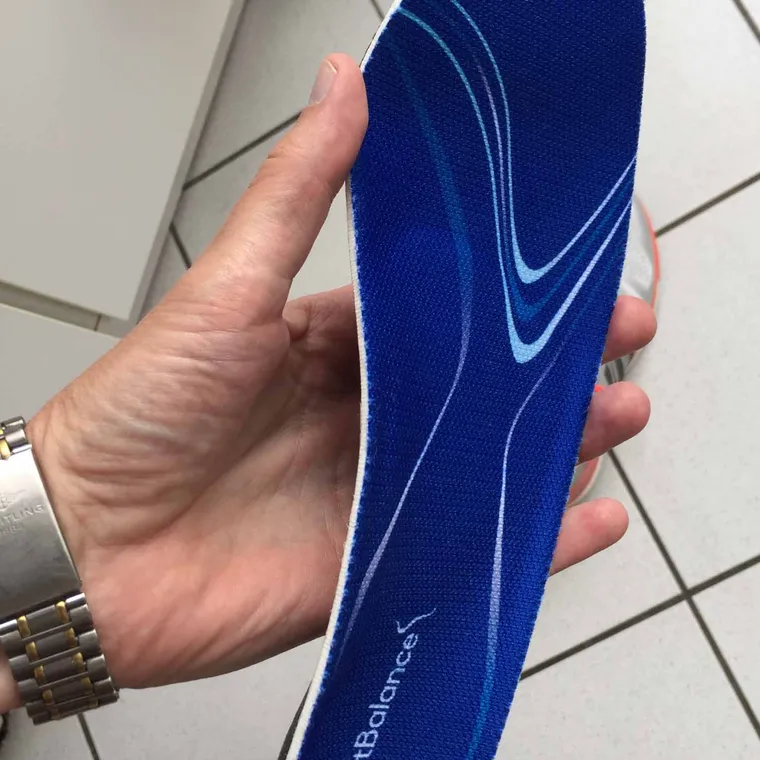
Image credits: insole photographs via Wikimedia Commons, Luca Cascianini (CC BY-SA 4.0) and Cogitato (CC BY-SA 4.0).

About the author
Alex Moreno writes the everyday-gear guides at Lume-Trixa. He buys the products with his own money, uses them for weeks rather than an afternoon, then reads the published research behind the idea. He is not a doctor, podiatrist or physiotherapist, and every foot and leg guide he writes says so.
More about Alex Moreno ›Keep reading
- Why do my feet hurt after standing all day? The pattern behind end-of-shift foot pain, the four-point self-check, and what actually takes the load off.
- Custom orthotics vs insoles: which is worth your money? What the head-to-head trials found, and when a moulded prescription pair is genuinely worth the extra.
Affiliate disclosure: some links on this page are affiliate links. If you buy through them we may earn a commission, at no additional cost to you. This does not affect our editorial assessment or the scores we publish. Content in this guide is general information about products and published research, not medical advice, and it is not a substitute for having a persistent problem examined by a clinician.