For most people standing all day, start with an off-the-shelf pair. When Whittaker and colleagues pooled nineteen trials, custom-moulded orthoses showed no advantage over prefabricated ones at any follow-up point. Custom work earns its price when a clinician finds a structural reason for it, not by default.
Alex Moreno is a gear reviewer, not a doctor, podiatrist or physiotherapist. This guide describes products and published research. It is not a diagnosis of your feet.
Affiliate disclosure: some links below are affiliate links. If you buy through them, Lume-Trixa may earn a commission at no extra cost to you. It does not change what this guide says or which studies it cites.
What is the actual difference between the two?
One is made from a mould of your foot by a clinician. The other is made in a factory in a range of sizes and shapes, and you pick the one that fits.
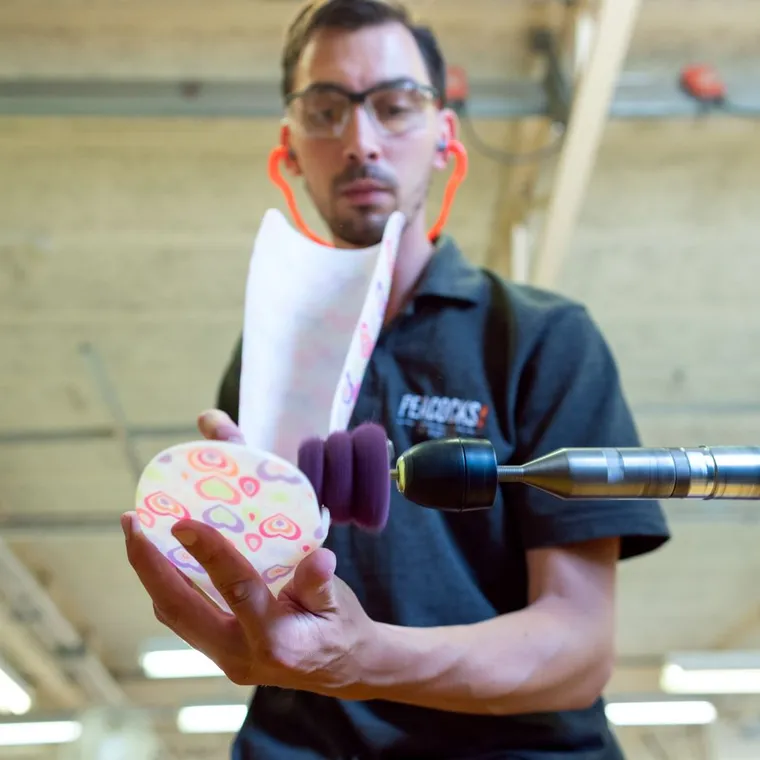
A custom orthotic, sometimes called a prescription orthotic, starts with an appointment. A podiatrist or orthotist looks at your feet, watches how you stand and walk, then takes an impression using a foam box, a plaster cast or a scanner. That impression goes to a lab, a device is built to it, and you come back to have it fitted and adjusted. You are paying for the assessment, the fabrication and the follow-up, and that is a professional service rather than a product off a shelf.
An off-the-shelf insole, also called a prefabricated orthosis in the research, arrives in a box. The good ones are full-length, have a defined arch shape rather than flat foam, and come in sizes you either match or trim to fit. There is no appointment, no cast, and no waiting list.
Do custom orthotics work better than off-the-shelf insoles?
In the pooled trial evidence, no. They came out level.
Whittaker, Munteanu, Menz and colleagues published a systematic review and meta-analysis in the British Journal of Sports Medicine in 2018, covering 19 randomised trials and 1,660 participants with plantar heel pain. Their comparison of customised against prefabricated foot orthoses showed no difference at any time point: not at 0 to 6 weeks, not at 7 to 12 weeks, not at 13 to 52 weeks.
The same review is where the positive finding for the category comes from. In the medium term, 7 to 12 weeks, there was moderate-quality evidence that foot orthoses reduced pain more than sham insoles. So the honest summary is that the trials support the idea of putting a shaped support under the foot, and do not support paying more for a moulded one as a general rule.
Two limits worth stating plainly. Those trials tested categories of device rather than any brand on sale today, so nobody, including us, gets to convert that data into evidence about a specific product. And they studied plantar heel pain specifically, which is the most-researched version of this problem rather than every foot complaint that exists.
Where we would put the first money
An off-the-shelf pair built for full days on hard floors. We bought Akusoli, wore it through eight-hour shifts, and wrote up the fit in work shoes, the textured surface and the terms if you send it back.
See the current price and the guarantee on the official storeOr read the full Akusoli insoles review, with the sizing notes and what the insole research does and does not say.
How do the two routes compare in practice?
| Off-the-shelf insole | Custom orthotic | |
|---|---|---|
| How you get it | Ordered and worn the same week | Assessment, mould, lab build, fitting appointment |
| Fitted to your foot | By size and shape you select | By a mould of your own foot, adjusted after fitting |
| Trial evidence | No difference from custom at any time point in Whittaker 2018 | No advantage over prefabricated at any time point in Whittaker 2018 |
| Cost | A consumer purchase | A clinical service, typically several times the price |
| If it does not suit you | Returnable inside the seller's stated window | Made for you, so usually adjusted rather than refunded |
| Best fit for | Standing-all-day aches, tired feet, unsupported work shoes | A structural reason identified by a clinician who examined you |
When is a custom pair genuinely worth the money?
When someone has examined your feet and found a specific reason that a stock shape cannot address. That is the whole test, and it is a decision made in a clinic rather than on a website.
The situations that usually justify it are a marked structural difference in the foot, a real leg-length discrepancy that needs building into the device, a foot that has been through surgery or injury and no longer takes a standard shape, a rigid deformity that needs accommodating rather than supporting, and foot care under medical supervision where pressure has to be redistributed away from a specific area. In those cases the mould is the point, and buying a stock pair instead is the false economy.
If you have diabetes, reduced feeling in your feet, new one-sided swelling, or a sore that will not heal, see a clinician before relying on an insole or a massager, because those need a proper look. Reduced sensation in particular changes the whole calculation, because pressure you cannot feel is pressure you cannot self-monitor.
When does an off-the-shelf pair already do the job?
For the everyday version of this problem, which is most of it: feet that ache after a shift on hard floors, work shoes with a flat foam liner and nothing under the arch, tiredness and soreness that track with how many hours you stood rather than with an injury.
That does not mean any pair will do, and this is where people waste money. A thin flat gel insert is not the thing the trials studied. What you want is closer to what the research calls a prefabricated foot orthosis:
- Full lengthYou are covering an entire shift, and the ball of the foot takes a large share of the load in the second half of it.
- An arch shape you can feel when you stand on itThe shape is what does the mechanical work. Flat foam compresses within weeks of eight-hour days.
- Fits your actual work shoeTake the factory liner out first. If a pair lifts your heel out of the back of the shoe, it will not survive the week.
- A stated returns windowBecause the benefit in the trials landed at 7 to 12 weeks, a written guarantee is what makes a fair trial possible rather than a gamble.
How to judge the result is its own subject, and getting it wrong is the main reason people conclude that insoles do not work. We set out the timeline and the checkpoints in how long insoles take to work.
What do the acupressure nubs and magnets in some insoles do?
They change how the insole feels underfoot. That is a comfort feature, and it is worth treating as exactly that rather than as a medical mechanism.
Plenty of insoles sold for standing all day have a textured or nubbed surface, and some include magnets. The sensation is real: you notice the surface, it is often described as pleasant at the end of a long day, and some people prefer a pair specifically because of how it feels. Preference is a legitimate reason to choose one product over another, and comfort is most of why anyone keeps wearing a pair every day, which is the thing that actually determines whether it helps.
On magnets in particular, the National Center for Complementary and Integrative Health, part of the United States National Institutes of Health, states that scientific evidence does not support the use of magnets for pain relief. So nobody should be paying extra for the magnet, and we would not repeat a claim that goes further than that.
Keep the money where the evidence is. The part of any insole doing measurable work is the shape supporting your arch across the whole shift, and that is the part the randomised trials looked at. If a pair gets that right and also happens to feel good underfoot, you have both. If a pair only offers the feel, it is missing the half that matters.
What does each route really cost, and where is the risk?
The gap is not only the price, it is what happens if you get it wrong.
An off-the-shelf pair is a consumer purchase with a stated returns window. If it does not suit you, you send it back inside the window and you are out your time. A custom pair is a clinical service costing several times more, and because the device was made for your foot, the remedy for a disappointing result is usually an adjustment appointment rather than a refund. That asymmetry is the practical argument for the order we suggest, and it holds even before you look at the trial data.
There is a hidden cost on the other side too. If a clinician has told you that you need a moulded device for a structural reason, buying three stock pairs in a row instead is the expensive route, just spread out.
So which should you buy first?
Start with a good off-the-shelf pair, wear it every working day, and judge it properly at six and twelve weeks against a written baseline. That is the cheap, reversible, evidence-supported first move for the standing-all-day version of this problem, and for a lot of people it is also the last move.
If a fair trial of a decent pair does not settle it, that result is worth something: it is the point to book an assessment rather than to buy a fourth pair of something. Walk in with the answers to the four-point self-check from our guide on why feet hurt after standing all day, because where it hurts, when it hurts and what you have already tried is exactly the information that makes an appointment productive. An insole is a load-spreading device, not a substitute for having a persistent problem looked at.
The off-the-shelf pair we tested for eight-hour days
Akusoli is a full-length support and acupressure insole aimed at people who stand for a living. Our review covers fit in work shoes, the surface, the returns terms and our score.
See the current price and the guarantee on the official storeRead the full Akusoli insoles review first if you want the long version.
Frequently asked questions
Are custom orthotics worth it for standing all day?
For the ordinary standing-all-day ache, the trial data does not support paying the premium as a first step: Whittaker and colleagues found no difference between customised and prefabricated foot orthoses at any follow-up point across 19 trials. They are worth it when a clinician who has examined your feet identifies a structural reason a stock shape cannot address.
Can an off-the-shelf insole be as supportive as a moulded one?
In the pooled trials the two came out level on pain and function, which is the closest thing to an answer we have. What separates good from poor in the off-the-shelf category is full length, a defined arch shape you can feel when you stand on it, and a fit in the shoe you actually work in, rather than a thin flat gel pad.
Do magnetic or acupressure insoles relieve pain?
Treat them as comfort features. The National Center for Complementary and Integrative Health states that scientific evidence does not support the use of magnets for pain relief, so the magnet is not the reason to buy a pair. The support under the arch is the part with randomised trial evidence behind it, and a textured surface people enjoy is a bonus rather than a mechanism.
Do I need a referral or a diagnosis before buying insoles?
No, an off-the-shelf pair is a consumer product you can simply try. Get assessed first if you have diabetes, reduced feeling in your feet, new one-sided swelling or a sore that will not heal, and get assessed afterwards if a fair twelve-week trial has not changed anything. Buying a pair is not a substitute for having a persistent problem looked at.
Sources
- Whittaker GA, Munteanu SE, Menz HB, Tan JM, Rabusin CL, Landorf KB. "Foot orthoses for plantar heel pain: a systematic review and meta-analysis." British Journal of Sports Medicine, 2018;52(5):322-328. pubmed.ncbi.nlm.nih.gov/28935689
- National Center for Complementary and Integrative Health, National Institutes of Health. "Magnets for Pain: What You Need To Know." nccih.nih.gov
- American Academy of Orthopaedic Surgeons, OrthoInfo. "Plantar Fasciitis and Bone Spurs." orthoinfo.org
- Waters TR, Dick RB. "Evidence of health risks associated with prolonged standing at work and intervention effectiveness." Rehabilitation Nursing, 2015;40(3):148-165. pubmed.ncbi.nlm.nih.gov/25041875
Image credits: workshop and sore foot photographs via Pexels.

About the author
Alex Moreno writes the everyday-gear guides at Lume-Trixa. He buys the products with his own money, uses them for weeks rather than an afternoon, then reads the published research behind the idea. He is not a doctor, podiatrist or physiotherapist, and every foot and leg guide he writes says so.
More about Alex Moreno ›Keep reading
- Why do my feet hurt after standing all day? The pattern behind end-of-shift foot pain, the four-point self-check, and what actually takes the load off.
- How long do insoles take to work? The realistic window, why the first two weeks feel like nothing, and how to judge a pair before the returns period runs out.
Affiliate disclosure: some links on this page are affiliate links. If you buy through them we may earn a commission, at no additional cost to you. This does not affect our editorial assessment or the scores we publish. Content in this guide is general information about products and published research, not medical advice, and it is not a substitute for having a persistent problem examined by a clinician.