You calm your nervous system by feeding it signals it reads as safety: a slower out-breath than in-breath, daily movement, a protected wind-down before bed, and consistent sleep. Slow breathing under ten breaths a minute has the strongest evidence behind it. The change is a shift in your baseline over weeks, not a switch you flip.
Alex Moreno is a consumer gear reviewer, not a doctor or a therapist. This guide explains published research and the devices built around it. It is general information, not medical advice, and the safety box below applies before you try any nerve stimulation device.
Affiliate disclosure: some links below are affiliate links. If you buy through them, Lume-Trixa may earn a commission at no extra cost to you. It does not change what this guide says or which studies it cites.
What is actually happening when your nervous system will not settle?
Two systems are running your body in the background, and one of them is winning more often than it should.
The autonomic nervous system is the part you do not consciously drive. It handles your heartbeat, your breathing rate, digestion, sweating and pupil size. It has two branches, and the easiest way to picture them is a car.
The sympathetic branch is the accelerator. It speeds the heart, tightens muscles, pushes blood to the limbs and sharpens attention. It is what you want when a car pulls out in front of you or a deadline lands on your desk.
The parasympathetic branch is the brake, and the vagus nerve is the main cable it runs on. The vagus is a long nerve that leaves the brainstem, passes down through the neck and reaches the heart, lungs and gut. When it is active you get a slower heart rate, easier digestion, and the state people describe as feeling settled.
Neither branch is good or bad. The problem is the ratio. A working week with no genuine off switch keeps the accelerator lightly pressed for hours at a time, and the brake never gets a proper turn. Calming your nervous system down is not about deleting stress. It is about giving the brake more input, more often.
Why do you feel exhausted but wired at night?
Because tiredness and arousal are produced by different systems, and a long stressful day raises both at once.
Sleep pressure builds through the day no matter what. Nervous system arousal builds too, and it does not drain just because you closed the laptop. So you arrive at eleven at night genuinely worn out, lie down, and find your mind still auditing the day while your heart is beating faster than the situation calls for. Exhausted, and still switched on.
This is not a rare complaint. Gallup's State of the Global Workplace 2024 report found that 41 percent of employees experience a lot of daily stress. In Great Britain, the Health and Safety Executive reported 22.1 million working days lost to work-related stress, depression or anxiety in 2024 and 2025. The World Health Organization estimates that anxiety and depression cost 12 billion working days globally every year.
Read those together and the picture is plain: the tired and wired evening is close to a normal outcome of modern work, not a personal defect. What changes it is not willpower at eleven at night. It is what you do earlier and more regularly.

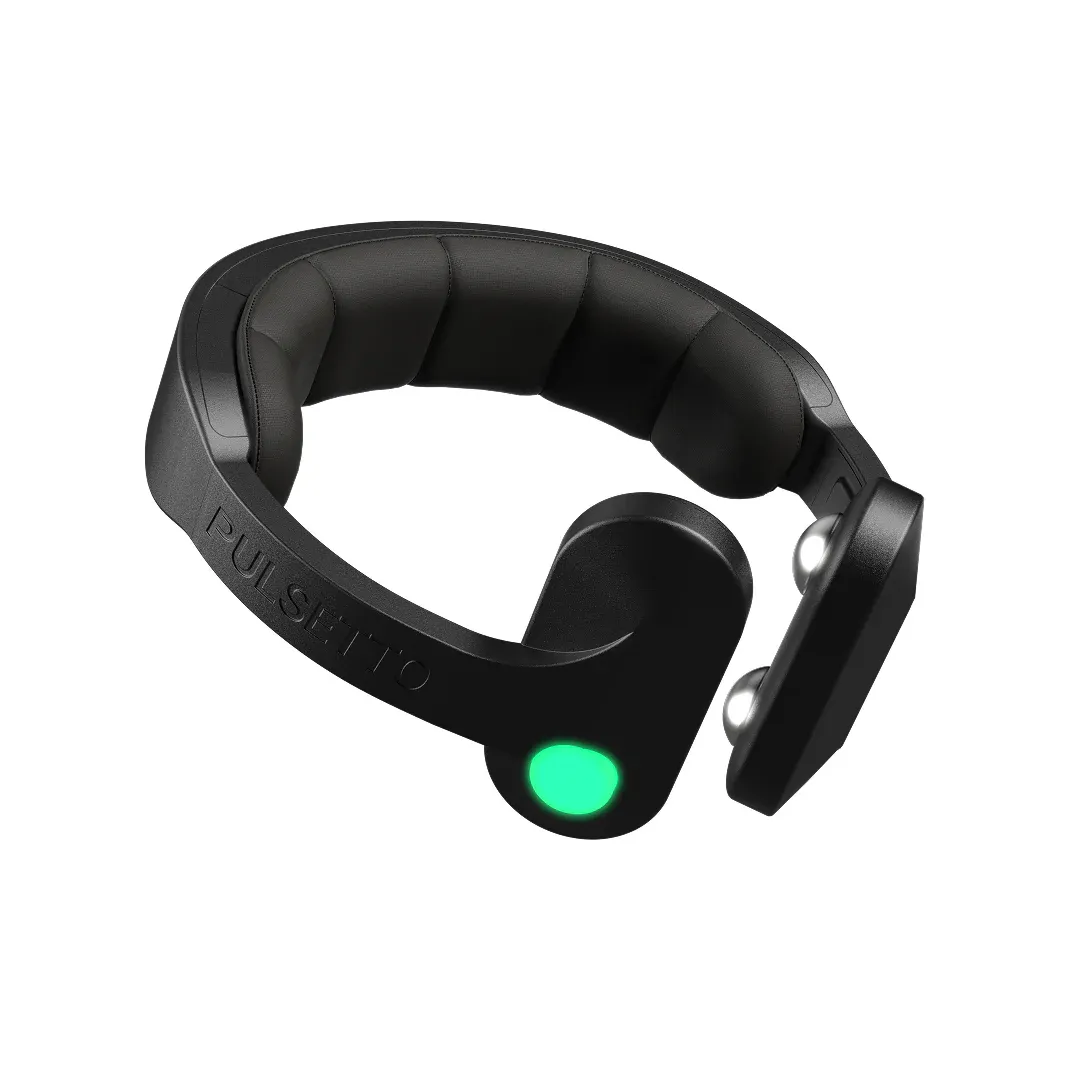
The bottom-up option: a four-minute daily input
The Pulsetto Fit is a wearable neck device that sends gentle pulses through the skin in short app-guided sessions. Our review covers how it feels, the app, the battery, and the realistic timeline before anything changes.
Check the current price and what is in the box on the official storeOr read our full Pulsetto Fit review, with the session length, the price and the return terms.
What is heart rate variability, and why does everyone quote it?
Heart rate variability, usually shortened to HRV, is the tiny variation in the gap between one heartbeat and the next. It became the number everyone quotes because it is the cheapest window we have into that accelerator and brake balance.
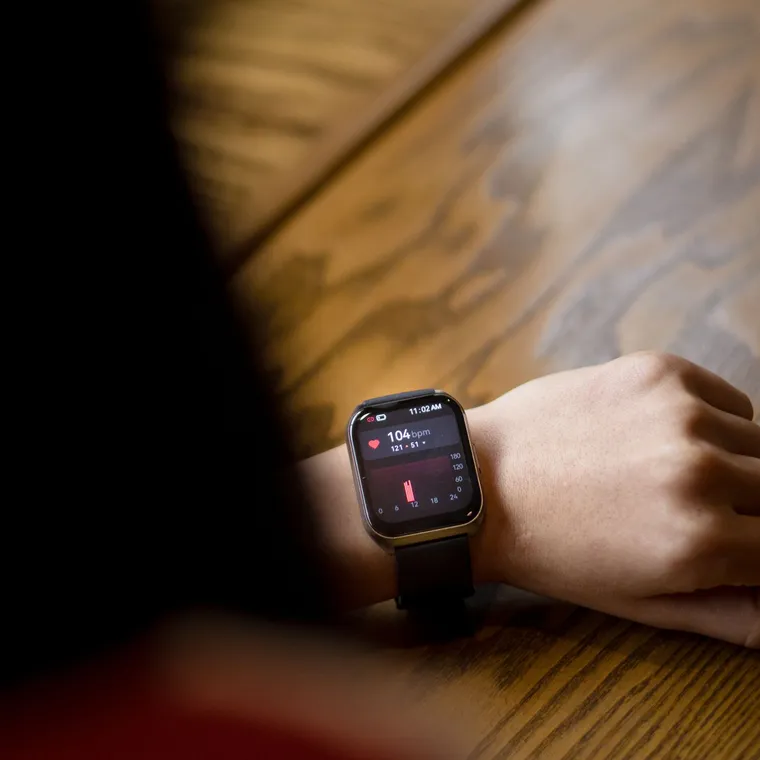
A heart at 60 beats a minute is not ticking out a beat exactly every second. The gaps flex slightly, and a lot of that flexing comes from the vagus nerve adjusting the heart beat by beat. More flex generally means the brake is engaged and responsive. Less flex tends to show up in people under sustained load. That is the whole reason your watch or ring puts an HRV number on the screen every morning.
How well does stimulating the vagus nerve move that number? There is a systematic review that went looking. Soltani, Azizi, Sima and colleagues published it in Clinical Autonomic Research in 2023. They screened 2,458 studies and included 21 that measured what non-invasive ear stimulation of the vagus nerve did to heart rate variability in healthy people.
The results are worth reading carefully, because they are both encouraging and a fair warning. A significant change was found in SDNN in 86 percent of the studies, in RMSSD in 75 percent, and in pNN50 in 69 percent. Those are the indices most closely tied to vagal activity. The others moved much less consistently: high frequency power in 47 percent, the LF to HF ratio in 36 percent, and low frequency power in 25 percent.
The honest reading is this. The measures that track the vagus most directly moved in the majority of studies, which is a genuine signal. The wider set did not, and the stimulation settings still vary a lot from study to study, so nobody can hand you one settled protocol yet.
One line matters more than the rest: those studies tested the modality, stimulation of the vagus nerve, not any product you can buy. No brand owns that data, and we do not convert it into proof about any specific device either.
How do you know if your nervous system is stuck on?
You do not need a wearable to work this out. Four questions, answered honestly, tell you more than a month of screenshots. Write your answers down today so you have something to compare against later.
- 1. How long does it take you to fall asleep?Under twenty minutes most nights is unremarkable. Forty-five minutes of lying there replaying conversations is the accelerator still running.
- 2. Do you wake in the night, and can you get back to sleep?Waking briefly is normal. Waking at three, feeling instantly alert and mentally back at work, is the signal worth noticing.
- 3. How long after you stop working do you actually feel calm?Time it from closing the laptop to the moment your shoulders drop. Twenty minutes is one thing. Never getting there before bed is another.
- 4. What does your body do at a small annoyance?Traffic, a slow queue, a short email. If a minor irritation produces a jaw clench and a heart thump, your baseline is already high and small things are landing on top of it.
Score it roughly. Nought or one flagged answer, you are fine. Two, keep an eye on it. Three or four, your nervous system is spending most of its day on the accelerator, and that is worth doing something deliberate about. Repeat the same four questions in four weeks rather than trusting your memory, because memory quietly resets to how you feel today.
What actually changes your nervous system tone?
Four inputs do most of the work, and none of them are exotic. What they share is repetition. A single good evening changes almost nothing. Six weeks of small daily inputs is what moves a baseline.
Slow breathing, the one with the best evidence
Zaccaro, Piarulli, Laurino and colleagues published a systematic review in Frontiers in Human Neuroscience in 2018. From 2,461 abstracts screened they included 15 studies, and defined slow breathing as fewer than ten breaths per minute. Slow breathing was associated with higher heart rate variability, along with more EEG alpha activity and less theta. On the psychological side the pattern was more vigor and alertness, with reduced anxiety, depression, anger and confusion.
The practical version fits in one line: breathe in for four, out for six, for five minutes. The longer exhale is the active ingredient. Our guide on how to stimulate the vagus nerve naturally walks through that pattern and the other free methods properly.
Movement, most days
Regular aerobic exercise is one of the most reliable ways to change how your body handles stress load. It also gives the accelerator something to actually do, which a spreadsheet never provides. Walking counts. Consistency counts more than intensity.
Sleep timing you protect
A steady wake time and a genuine wind-down do more for your daytime baseline than any single evening technique. Sleep is where the recovery happens, so a nervous system routine that ends at midnight is fighting itself.
A direct input that does not depend on willpower
Here is the gap in the list above. Breathing, meditation and journalling are top-down methods: they ask your thinking brain to talk your stressed brain down. That is precisely the resource that is empty at the end of a hard day, which is why the technique you know works is the one you skip when you need it.
Wearable vagus nerve stimulators take the other route. They send a mild current through the skin of the neck, bottom-up, and a session runs in about four minutes with no focus required from you. That is a different kind of daily input, and it is the reason a lot of people use one alongside the breathing rather than instead of it. Do both, because they are not the same lever.
What does a realistic evening actually look like?
Not a spa. A sequence of small signals in the last ninety minutes of the day, in an order you can repeat when you are tired.
- A hard stop on work. One clear moment when the laptop closes and the work phone goes face down in another room. The point is the boundary, not the device.
- Ten minutes of movement. A short walk after dinner, or tidying up. It burns off the last of the accelerator instead of taking it to bed.
- Five minutes of slow breathing, or one short device session. Same slot every night so it becomes automatic rather than a decision.
- Lower the light. Overhead lights off, lamps on, screens dimmed for the final half hour.
- Same wake time tomorrow. The one variable with the biggest effect on how the next evening goes.
Judge it at four weeks with the same four questions from the self-check. If nothing at all has moved by then, that is useful information and a reason to talk to a professional rather than to buy something else.
Do not use a vagus nerve stimulator if you have a pacemaker, a cochlear implant, or another active implanted electrical device. Talk to a doctor before use if you are pregnant, have epilepsy, or have any heart condition. If anxiety or sleep problems are persistent, that is a conversation with a professional, and no device changes that.
If you want the device route as well as the breathing
The Pulsetto Fit runs four-minute app-guided sessions and is built as a daily self-regulation tool, not a treatment. Most people describe a change in baseline after two to four weeks of consistent use.
Check the current price and what is in the box on the official storeUndecided? Start with does vagus nerve stimulation actually work, and what the evidence covers.
Frequently asked questions
How long does it take to calm your nervous system down?
A single slow breathing session can change how you feel within a few minutes, but that is a state change and it fades. Shifting your baseline, meaning how reactive you are by default, is the part that takes weeks of repetition. Four to six weeks of daily input is a fair window before you judge whether anything has changed.
Is a low HRV reading something to worry about?
Not on its own. HRV varies enormously between people, and your own number swings with alcohol, illness, a late meal, hard training and a poor night's sleep. It is useful as a trend across weeks and close to meaningless as a single morning verdict. How you sleep, how fast you settle and how you react to small annoyances tell you more.
What is the fastest way to calm down in the moment?
Extend your exhale. Breathe in through the nose for a count of four and out for a count of six, and keep going for a couple of minutes. The long out-breath is the part that engages the brake, and it works standing in a corridor before a meeting, which is the main reason to prefer it over anything more elaborate.
Do vagus nerve devices replace breathing exercises or therapy?
No. A consumer device is a daily self-regulation tool that runs without needing your concentration, which makes it a useful addition on the days when you skip the breathing. It is not medicine and it is not therapy. If you are managing a diagnosed condition, talk to your doctor first and treat any device as an addition to your care, never a substitute.
Sources
- Soltani D, Azizi B, Sima S, et al. "A systematic review of the effects of transcutaneous auricular vagus nerve stimulation on baroreflex sensitivity and heart rate variability in healthy subjects." Clinical Autonomic Research, 2023;33(2):165-189. pubmed.ncbi.nlm.nih.gov/37119426
- Zaccaro A, Piarulli A, Laurino M, et al. "How Breath-Control Can Change Your Life: A Systematic Review on Psycho-Physiological Correlates of Slow Breathing." Frontiers in Human Neuroscience, 2018;12:353. pmc.ncbi.nlm.nih.gov/articles/PMC6137615
- Gallup. "State of the Global Workplace 2024", employee daily stress levels. gallup.com/workplace
- Health and Safety Executive (Great Britain). "Work-related stress, depression or anxiety statistics in Great Britain, 2025", working days lost in 2024 and 2025. hse.gov.uk/statistics
- World Health Organization. "Mental health at work" fact sheet, 12 billion working days lost globally each year. who.int
Image credits: photographs via Pexels.

About the author
Alex Moreno writes the everyday-gear guides at Lume-Trixa. He buys the products with his own money, uses them for weeks rather than an afternoon, then reads the published research behind the idea. He is not a doctor or a therapist, and every stress and sleep guide he writes says so.
More about Alex Moreno ›Keep reading
- Does vagus nerve stimulation actually work? The three layers of evidence, from the implanted therapy to the consumer wellness claims, with what each one does and does not cover.
- How to stimulate the vagus nerve naturally The free methods done properly: slow breathing, the long exhale, humming, brief cold, movement and sleep.
Affiliate disclosure: some links on this page are affiliate links. If you buy through them we may earn a commission, at no additional cost to you. This does not affect our editorial assessment or the scores we publish. Content in this guide is general information about consumer products and published research, not medical advice, and it is not a substitute for care from a qualified professional.