It depends which version you mean. Implanted vagus nerve stimulation is an established medical treatment for epilepsy and hard-to-treat depression. Non-invasive neck devices are FDA cleared for certain headaches. Consumer wellness stimulators have a smaller, promising but unsettled body of research on stress markers and sleep, and are best read as a daily self-regulation tool rather than a treatment.
Alex Moreno is a consumer gear reviewer, not a doctor or a therapist. This guide explains published research and the devices built around it. It is general information, not medical advice, and the safety box below applies before you try any nerve stimulation device.
Affiliate disclosure: some links below are affiliate links. If you buy through them, Lume-Trixa may earn a commission at no extra cost to you. It does not change what this guide says or which studies it cites.
Why the answer has three layers
People ask one question, "does vagus nerve stimulation work", but the phrase covers three quite different things, and lumping them together is how both the hype and the dismissals happen. It helps to separate them by how invasive they are and how much evidence sits behind each one.
The first is implanted stimulation, a surgical device. The second is non-invasive stimulation done through the skin of the neck with a medical device, prescribed for a specific diagnosis. The third is the consumer version, a wearable you buy without a prescription and use at home for general stress and sleep. The evidence gets thinner as you move down that list, and so does the claim any honest device should make.
Layer one: the implanted therapy is well established
This is the part that is not in dispute. A surgically implanted vagus nerve stimulator, a small pulse generator wired to the vagus nerve in the neck, has been an approved treatment for hard-to-control epilepsy since the late 1990s and for treatment-resistant depression since the mid 2000s. It is prescribed, fitted and monitored by specialists, and it is used when other treatments have not worked.
Why it matters to the question: it establishes that stimulating the vagus nerve can produce a real, measurable clinical effect. The mechanism is not folklore. What it does not tell you is anything about a wearable you clip round your neck at home, because the dose, the placement and the patient group are all completely different.
Layer two: non-invasive neck devices are FDA cleared for headache
Between the implant and the wellness gadget sits a medical device you hold against your neck, no surgery involved. The best known is gammaCore, a handheld non-invasive vagus nerve stimulator. It is FDA cleared for the acute and preventive treatment of cluster headache and the acute treatment of migraine, and that clearance was based on phase 3 randomised trials, the ACT-1, ACT-2 and PREVA studies.
This is the layer most people do not know about, and it is the one that matters most for judging a consumer device fairly. It shows that delivering stimulation to the vagus nerve through the skin of the neck, without an implant, is a real regulated route with trial evidence behind it for at least one use. It is not a marketing invention. A wellness wearable uses a similar idea in a lighter form, for a different purpose, without that level of testing.
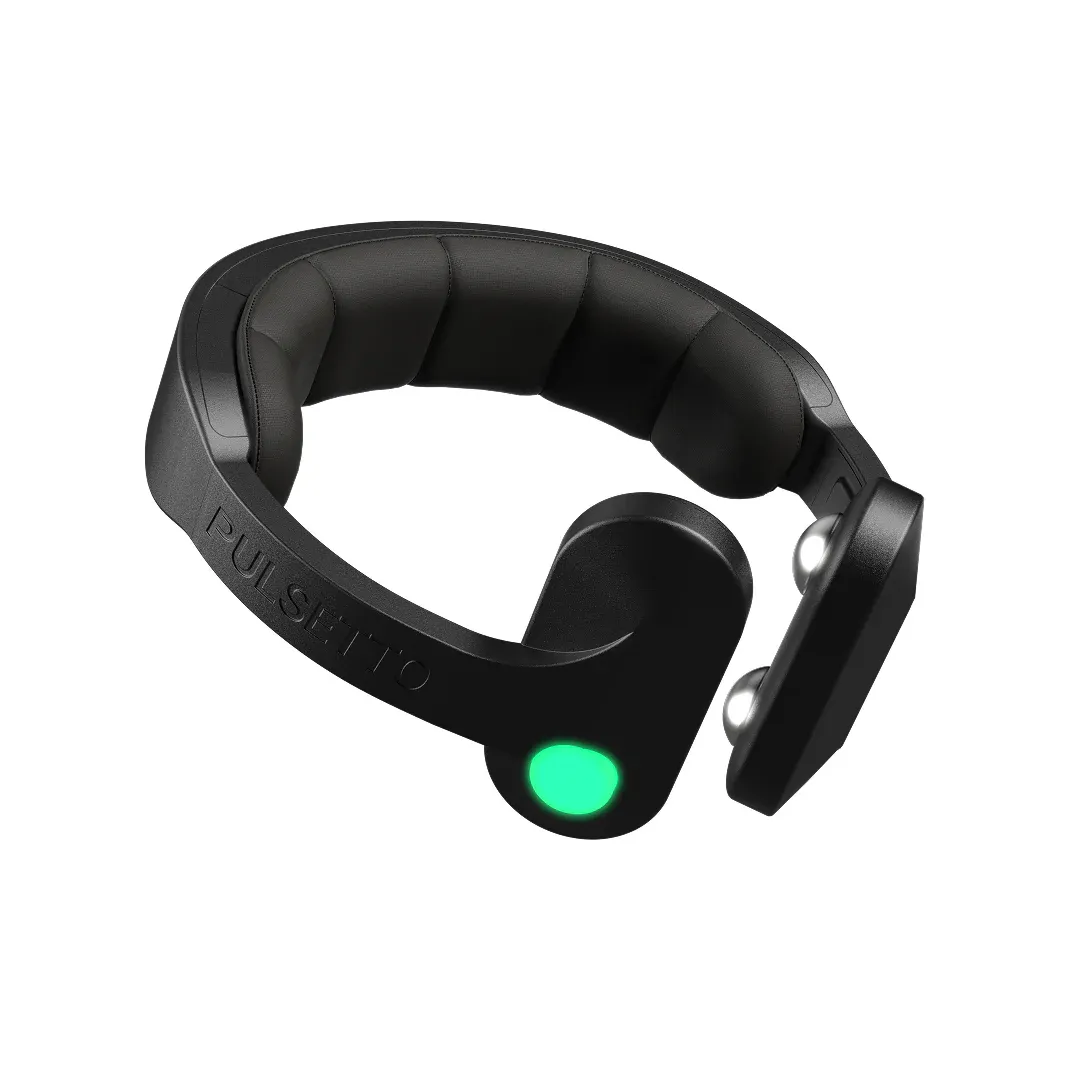
The consumer version we reviewed
The Pulsetto Fit is a wearable neck device that runs short app-guided sessions through the skin. Our review is clear about what it is, a daily self-regulation tool, and what it is not, a treatment for a diagnosed condition.
Check the current price and what is in the box on the official storeOr read our full Pulsetto Fit review, with the session length, the price and the return terms.
Layer three: what the consumer research actually shows
This is where the honest answer gets more careful, and where a buyer deserves the real picture rather than either the sales copy or a flat "it is a scam".
The most useful summary of the mechanism question is a systematic review by Soltani, Azizi, Sima and colleagues, published in Clinical Autonomic Research in 2023. They screened 2,458 studies and included 21 that measured what non-invasive ear stimulation of the vagus nerve did to heart rate variability in healthy people. The indices most tightly linked to vagal activity moved in the majority of studies: a significant change in SDNN in 86 percent of them, in RMSSD in 75 percent, and in pNN50 in 69 percent. The wider set of measures moved far less consistently, and the stimulation settings differed a lot from study to study, so there is no single agreed protocol yet.
On outcomes people actually care about, sleep and calm, there is early trial data. Lin and colleagues published a systematic review and meta-analysis in Psychology, Health & Medicine in 2026, pooling randomised trials of transcutaneous ear stimulation in people with sleep disorders. Across 11 trials that could be combined, stimulation improved sleep quality and reduced the time taken to fall asleep, with a favourable safety profile and only mild side effects. The authors are explicit that, given the variation between studies, the findings are preliminary and need confirmation in larger trials.
One line matters more than the rest. Those studies tested the modality, stimulation of the vagus nerve, not any product you can buy. No brand owns that data, and nobody, us included, should convert it into proof about a specific device.
So what should you expect from a wearable?
Set the expectation from the research, not the packaging. A consumer vagus nerve stimulator is a daily input aimed at your baseline stress level, not a switch that stops anxiety. In the studies and in user reports, the pattern is cumulative: most people who notice something describe it after two to four weeks of daily use, as a gradual shift toward a calmer default and easier sleep onset, rather than an instant effect in one session.
People who use one sporadically tend to report little. People who commit to a short daily session for a month are the ones who report a change. If you want a device that does something obvious the first time you use it, this is not that, and any page that promises it is overselling.
It also is not a replacement for anything. If you are managing diagnosed anxiety or depression, a wearable is at most an addition to your care, chosen with your doctor, never a substitute for treatment or therapy.
The honest verdict
Does vagus nerve stimulation work? At the medical end, yes, with decades of use behind it. In the middle, yes for specific headache conditions, with phase 3 trials behind it. At the consumer end, the fair answer is that there is a real mechanism and promising early evidence for stress markers and sleep, that the effect is small and builds slowly, and that it is unproven for any specific product. That is enough to make a wearable a reasonable thing to try as a daily habit, alongside the free methods, if the price and the return window make sense to you. It is not enough to treat it as medicine.
Do not use a vagus nerve stimulator if you have a pacemaker, a cochlear implant, or another active implanted electrical device. Talk to a doctor before use if you are pregnant, have epilepsy, or have any heart condition. If anxiety or sleep problems are persistent, that is a conversation with a professional, and no device changes that.
If a daily four-minute habit is what you are after
The Pulsetto Fit runs short app-guided sessions and is built as a self-regulation tool, not a treatment. Our review has the realistic timeline, the price against the Lite model, and the return terms.
Check the current price and what is in the box on the official storeBackground first? Read how do you calm your nervous system down, which covers the accelerator and the brake.
Frequently asked questions
Is vagus nerve stimulation scientifically proven?
For the implanted therapy in epilepsy and treatment-resistant depression, yes. For non-invasive neck devices in migraine and cluster headache, yes, based on phase 3 trials. For consumer wellness wearables used for general stress and sleep, the evidence is early and promising rather than settled: systematic reviews find effects on vagal heart rate variability indices and on sleep in clinical trials, but the studies vary and no specific product has been proven.
How long until a consumer device does anything?
Most people who report a change describe it after two to four weeks of daily use, and describe it as a gradual shift in baseline rather than an instant calm. A minority notice something in the first few sessions. Sporadic use tends to produce little. If you try one, give it a consistent month before you judge it.
Can a wearable replace anxiety medication or therapy?
No. A consumer vagus nerve stimulator is a self-regulation tool, not a treatment. If you are managing a diagnosed condition, anything like this is at most an addition to your care, decided with your doctor, and never a reason to change or stop prescribed treatment.
Is the neck version the same as the ear clips you see online?
They target the vagus nerve at different points. Much of the published consumer research uses ear stimulation, while devices like gammaCore and the Pulsetto sit on the neck. The broad mechanism is related, but you cannot assume a result from one placement transfers exactly to the other, which is part of why the evidence base is still described as unsettled.
Sources
- Soltani D, Azizi B, Sima S, et al. "A systematic review of the effects of transcutaneous auricular vagus nerve stimulation on baroreflex sensitivity and heart rate variability in healthy subjects." Clinical Autonomic Research, 2023;33(2):165-189. pubmed.ncbi.nlm.nih.gov/37119426
- Lin Z, Wang D, Nie Y, Tan C, Liu Z. "Transcutaneous auricular vagus nerve stimulation for sleep disorders: a systematic review and meta-analysis of sleep, anxiety, depression, and safety outcomes." Psychology, Health & Medicine, 2026. pubmed.ncbi.nlm.nih.gov/42522355
- US Food and Drug Administration, device clearance summary for gammaCore non-invasive vagus nerve stimulator, cleared for acute and preventive treatment of cluster headache and acute treatment of migraine. accessdata.fda.gov
Image credits: photographs via Pexels.

About the author
Alex Moreno writes the everyday-gear guides at Lume-Trixa. He buys the products with his own money, uses them for weeks rather than an afternoon, then reads the published research behind the idea. He is not a doctor or a therapist, and every stress and sleep guide he writes says so.
More about Alex Moreno ›Keep reading
- How do you calm your nervous system down? The accelerator and the brake in plain English, what HRV really tells you, and the daily inputs that shift your baseline.
- How to stimulate the vagus nerve naturally The free methods done properly: slow breathing, the long exhale, humming, brief cold, movement and sleep.
Affiliate disclosure: some links on this page are affiliate links. If you buy through them we may earn a commission, at no additional cost to you. This does not affect our editorial assessment or the scores we publish. Content in this guide is general information about consumer products and published research, not medical advice, and it is not a substitute for care from a qualified professional.