There is real evidence that it can. A 2021 meta-analysis of 42 randomised trials found foot reflexology improved sleep quality scores, and a well-known study showed that warming the feet helps people fall asleep faster. The catch is that the trials used hands-on massage by another person, so a home device is a practical stand-in for that, not the thing that was actually tested.
Alex Moreno is a gear reviewer, not a doctor or a sleep specialist. This guide describes published research and everyday habits. It is general information, not medical advice, and the safety box below lists who should check with a clinician first.
Affiliate disclosure: some links below are affiliate links. If you buy through them, Lume-Trixa may earn a commission at no extra cost to you. It does not change what this guide says or which studies it cites.
What does the research actually say?
Better than you might expect for something that sounds like a spa add-on.
The main piece is a systematic review and meta-analysis by Huang, Chen, Kuo and Chen, published in the Journal of Advanced Nursing in 2021. They pooled 42 randomised controlled trials with a total of 3,928 participants, looking at whether foot reflexology, structured pressure applied to the feet, changed sleep. The most common way the studies measured sleep was the Pittsburgh Sleep Quality Index, a standard questionnaire where a higher score means worse sleep.
The pooled result was a clear improvement in sleep quality scores in the groups that received foot reflexology compared with controls, reported as a large effect size (Hedges' g of -1.37, meaning the score dropped, which is the direction you want). Participants who received the intervention were also considerably less likely to be classed as having a sleep problem afterwards. The authors' conclusion was that foot reflexology produced significant improvements in sleep disturbances and can be considered a complementary approach.
Why warm feet help you drop off faster
There is a separate and older piece of research that explains part of the mechanism, and it is about temperature rather than pressure.
Kräuchi and colleagues published a short paper in Nature in 1999 titled, plainly, "Warm feet promote the rapid onset of sleep." The body lowers its core temperature to fall asleep, and it does that partly by sending blood to the hands and feet to shed heat. Warming your feet in the evening widens those vessels and helps that heat-loss process along, which is associated with falling asleep sooner.
This is why a warm foot bath before bed is a genuinely evidence-linked habit, and why any device that combines warmth with foot pressure is working on two plausible mechanisms at once rather than one.
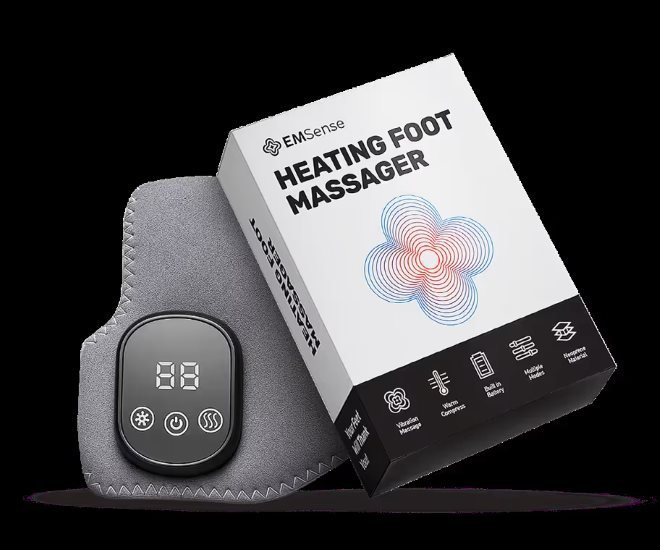
Warmth plus pressure, without doing it by hand
The EMSense is a cordless neoprene wrap that combines vibration massage with gentle warming on a timed 15 to 20 minute session. It is a comfort device for the evening, not a medical treatment, and our review is clear about that line.
See the current price and the return window on the official storeOr read our full EMSense heated foot massager review, with the modes, the session length and what it does not do.
Does a machine give you the same thing as a real massage?
This is the honest gap, and it is worth stating plainly rather than glossing over.
The trials in the meta-analysis used a trained person applying specific pressure to specific parts of the foot, often for a set number of weekly sessions. A home massager does not replicate that. It applies broad vibration, air compression and heat on a timer. It is reasonable to expect it delivers a version of the same inputs, sustained warmth and repeated pressure through the foot, but nobody has run 42 trials on a plug-in wrap, and it would be dishonest to pretend the reflexology effect size is the device's result.
What a device does have going for it is consistency and low effort. The reason people stop doing evening routines is that the hot towel goes cold, the foot bath is a faff to fill and empty, and massaging your own feet properly after a long day is more tiring than it sounds. A device that holds the heat for the whole session and runs the pressure for you is the version people actually keep doing every night, and a routine you keep beats a better one you abandon.
How to use it for sleep, specifically
Timing and consistency matter more than the settings.
- Run it in the last hour before bedThe warm-feet effect is about helping your core temperature drop as you settle, so a session that finishes shortly before you lie down fits the mechanism better than one at 6pm.
- Keep the heat comfortable, not maximalYou want pleasant warmth, not a burn. Turning it to the highest setting does not make it work better and can leave your feet feeling worse.
- Same slot every nightThe sleep benefit in the trials came from repeated sessions over weeks, not one-offs. Attach it to an existing habit so it happens automatically.
- Pair it with the rest of the wind-downLower lights, screens down, a steady wake time. The foot routine is one input, not the whole plan.
- Give it three to four weeks before you judge itTrack how long you take to fall asleep and how rested you feel, ideally noted down, rather than trusting memory.
If you have diabetes, reduced feeling in your feet, new one-sided swelling, or a sore that will not heal, talk to a doctor or podiatrist before using a heated foot device, because heat you cannot fully feel is heat you cannot safely judge. Persistent insomnia, or sleep problems that come with low mood or breathlessness, should be assessed by a professional rather than managed with a gadget.
The honest verdict
Does a foot massage help you sleep? The research on hands-on foot reflexology is genuinely positive, across a large number of trials, and the warm-feet effect on falling asleep faster is well established. A home massager is a practical, low-effort way to get a nightly version of warmth and foot pressure, which is a sensible thing to try as part of a wind-down. Just hold the expectation at the right level: it is a comfort and routine tool with plausible mechanisms behind it, not a treatment for a sleep disorder, and the strong trial numbers belong to the technique, not to any device on sale.
The device we use for the evening version
Cordless, warm compression plus vibration, and it shuts off on its own at the end of the session. Our review has the modes, the honest limits and our score.
See the current price and the return window on the official storeRead the full EMSense foot massager review first if you want the long version.
Frequently asked questions
Is there real evidence that foot massage helps sleep?
Yes, for hands-on foot reflexology. A 2021 meta-analysis in the Journal of Advanced Nursing pooled 42 randomised trials with 3,928 participants and found it improved sleep quality scores compared with controls, with a large effect size. Separately, a 1999 Nature study found that warming the feet helps people fall asleep faster. The trials used practitioner-applied massage, not a home device.
Will a foot massager work as well as a real massage therapist?
Probably not identically. A machine applies broad vibration, compression and heat on a timer rather than trained pressure to specific points. It is a reasonable stand-in for the warmth-and-pressure inputs, and it has consistency on its side because people keep using it, but the strong trial results are for hands-on reflexology and should not be presented as a device's own result.
When should I use it to help me sleep?
In the last hour before bed, on a comfortable rather than maximal heat setting, at the same time each night. The warm-feet mechanism is about helping your core temperature fall as you settle, so a session that finishes shortly before you lie down fits better than an early-evening one.
How long before I know if it is helping?
Give it three to four weeks of near-nightly use, and track how long you take to fall asleep and how rested you feel, ideally written down. The sleep benefit in the trials came from repeated sessions over weeks, so a single night is not a fair test.
Sources
- Huang HC, Chen KH, Kuo SF, Chen IH. "Can foot reflexology be a complementary therapy for sleep disturbances? Evidence appraisal through a meta-analysis of randomized controlled trials." Journal of Advanced Nursing, 2021;77(4):1683-1697. pubmed.ncbi.nlm.nih.gov/33615535
- Kräuchi K, Cajochen C, Werth E, Wirz-Justice A. "Warm feet promote the rapid onset of sleep." Nature, 1999;401(6748):36-37. pubmed.ncbi.nlm.nih.gov/10485703
Image credits: photographs via Pexels.

About the author
Alex Moreno writes the everyday-gear guides at Lume-Trixa. He buys the products with his own money, uses them for weeks rather than an afternoon, then reads the published research behind the idea. He is not a doctor or a sleep specialist, and every guide he writes on this topic says so.
More about Alex Moreno ›Keep reading
- Why do my legs feel heavy at the end of the day? The calf muscle pump, why night and hot weather are worse, and a 20 minute evening routine.
- Heat or cold for tired, aching feet? The one-line rule, the four things never to do, and where a heated massager fits.
Affiliate disclosure: some links on this page are affiliate links. If you buy through them we may earn a commission, at no additional cost to you. This does not affect our editorial assessment or the scores we publish. Content in this guide is general information about everyday habits and published research, not medical advice, and it is not a substitute for having a persistent problem examined by a clinician.