Body composition scales · Hands-on review
Hume Body Pod Review 2026: Is the AI Body Scanner Worth It, or Overpriced Tech?
A multi-frequency segmental bioimpedance scale that tracks visceral fat, muscle and hydration over time, aimed at people who want more than a weight number.
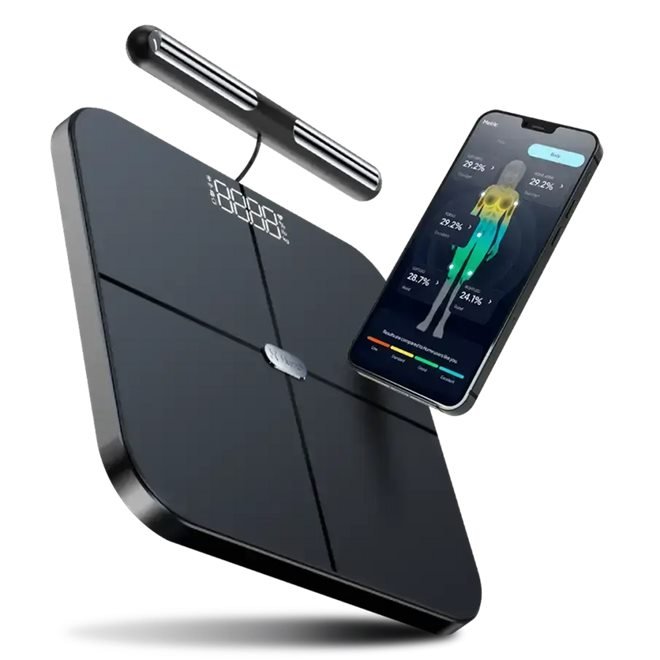
The Hume Body Pod is a legitimate multi-frequency segmental bioimpedance scale with a retractable handlebar. It reports body fat, segmental muscle, visceral fat, hydration and a modelled biological age. Its real strength is tracking the direction of change over weeks, not giving a lab-exact number on day one. Expect setup friction, an app that needs a couple of weeks of daily readings, and an AI subscription for the deeper analysis.
Why body composition beats a single weight number
A regular scale tells you total mass. It cannot tell you whether a 2 kg change was fat, muscle or water, and it says nothing about where fat sits. That last point matters more than most people realise.
Visceral fat, the fat packed around the organs, is an independent predictor of cardiovascular disease, type 2 diabetes and metabolic syndrome, even when total body fat and BMI look normal.1 Research summarised from work in the journal Circulation describes it as metabolically active tissue that drives vascular inflammation, and clinicians flag a visceral fat area above roughly 100 cm² as high cardiovascular risk.1 A plain scale gives you none of that. A body composition tool at least lets you watch the number move in the right direction as you change diet and training.
The clinical way to measure this is a DEXA scan, which runs about 40 to 200 dollars at a wellness clinic and 150 to 400 dollars at a medical facility, per visit.2 That cost, repeated every few weeks, is the gap a device like the Body Pod is trying to fill.
What is the Hume Body Pod, and how does it work?
It is a floor scale with a retractable handlebar. You step on the foot electrodes and hold the bar, which adds hand-to-foot electrodes so the device can measure your body in segments rather than just foot to foot.
It sends low-level multi-frequency electrical currents through the body and measures the resistance. Different tissues resist current differently, so from those readings plus your height, age and sex the device models body fat percentage, skeletal and segmental muscle mass, a visceral fat index, body water split into intracellular and extracellular, bone mass, basal metabolic rate and a modelled biological age. Readings sync to the Hume Health app on iOS or Android, and the app builds trend lines over time. Multi-frequency segmental hardware is the better class of consumer bioimpedance, ahead of the cheap foot-to-foot scales.
Our verdict at a glance
Editorial rating by the Lume-Trixa Review Team. A strong home trend tracker for engaged users. Not a lab, and the first week can be fiddly.
How accurate is the Hume Body Pod really?
Accurate enough to track change, not accurate enough to treat as a clinical reading. That is true of every consumer bioimpedance device, and the honest way to use one is to watch the trend, not obsess over a single day's number.
Independent comparisons put consumer bioimpedance body fat estimates within about 3 to 10 percent of a DEXA scan, against DEXA's own margin of roughly 0.8 to 2 percent.3 Multi-frequency segmental devices with hand electrodes, which is the category the Body Pod sits in, land at the better end of that range, closer to 2 to 4 percent in some device tests.3 Results also shift with hydration, time of day, recent meals and exercise, which is why consistency of routine matters more than the device.
Practical translation: weigh yourself at the same time of day, same conditions, ideally morning before food and water, and judge yourself on the four week line rather than today versus yesterday. Used that way the Body Pod is genuinely useful. Treated as a substitute for a DEXA scan, it will mislead you. Ignore any marketing that claims near-perfect agreement with clinical machines.
Check today's price on the official Hume storeDo you need the AI subscription?
The hardware gives you the raw measurements and basic trends for free. The paid Hume Health AI layer is what turns those into longitudinal analysis, biological age progression and tailored guidance. If the AI coaching is the reason you are buying, budget for the subscription.
This is a fair criticism of the marketing, which does not always make the split clear. Buyers who expected a fully standalone device felt short-changed when the deeper features sat behind a paywall. Decide before you buy whether you want the scale plus its own app trends, which is a complete product on its own, or the full AI ecosystem, which is an ongoing cost.
What are buyers saying after they bought the Body Pod?
The people who get the most out of it treat it as a daily habit and read the trend over weeks. Results vary from person to person.
The buyers who get the most out of it use it as a frequent trend tracker, weighing at the same time each day and watching the direction over weeks rather than fixating on a single reading.
"Nothing motivates me more than seeing the muscle I am adding while losing fat. Game changer."
Jenna H., 5 stars, TrustpilotThat is what owners come back to: watching muscle climb and body fat trend down over a training block, a segmental muscle breakdown that trainers actually use, and a visceral fat trend that several people say changed how they eat. Users who compared their trend against their own DEXA history report it lines up well after a couple of weeks of daily use. As a home tool you step on every morning, it gives you a direction to train against between lab scans.
Hume Body Pod vs DEXA vs a basic smart scale
These solve different problems. DEXA is the accuracy benchmark you pay for per visit. A cheap smart scale is a weight tool with a rough fat estimate. The Body Pod sits between them as a frequent-use trend tracker.
| Factor | Hume Body Pod | DEXA scan | Basic smart scale |
|---|---|---|---|
| Body fat margin vs DEXA | ~2-4% (segmental BIA)3 | Benchmark, ~0.8-2%3 | ~3-10%3 |
| Visceral fat | Modelled index, trend | Measured, area in cm² | Usually none or crude |
| Segmental muscle | Yes, by limb and trunk | Yes | No |
| Cost model | One-time, plus optional AI subscription | ~40-400 dollars per scan2 | Low one-time |
| Use frequency | Daily at home | Every few months | Daily at home |
| Best for | Watching change between scans | Ground-truth checkpoints | Weight, light fat trend |
The strongest setup is actually both: an occasional DEXA scan as a checkpoint, and the Body Pod for the weekly movement in between. If you will only ever want a weight number, save the money and buy a basic scale.
What are the pros and cons of the Hume Body Pod?
Pros
- Multi-frequency segmental bioimpedance, the better class
- Visceral fat, muscle and hydration trends in one device
- Solid trend accuracy after calibration
- Cheaper over time than repeat DEXA scans
- iOS and Android app with long-range history
- Money-back guarantee on official orders
Cons
- Not a clinical-accuracy device on any single reading
- First-week Bluetooth and setup friction
- Deeper AI analysis needs a paid subscription
- Support response times behind the category
- Needs consistent daily use to be worth it
- Biological age figure is a model, not a measurement
Who should buy the Body Pod, and who should skip it?
Buy it if you are actively changing your body, want to separate fat loss from muscle loss, care about the visceral fat trend, and will step on it under the same conditions most days for at least a few weeks.
Skip it if you only want your weight, if you will not commit to consistent daily readings, if you expected DEXA-level precision from a home scale, or if you need fast customer support. A basic smart scale or a periodic DEXA scan will serve those cases better.
Common objections, answered
"It is just an expensive smart scale"
It is a different class of hardware. Foot-to-foot scales guess from the legs up. The Body Pod adds hand electrodes and multiple frequencies to measure in segments, which is why its trend accuracy is closer to DEXA than a basic scale.3 Whether that is worth the price depends on how seriously you track.
"The numbers are not accurate"
No consumer bioimpedance device matches a lab on a single reading, and this one does not claim to in our assessment. Its value is the direction and size of change over weeks, measured under a consistent routine.
"You have to pay a subscription to use it"
You can use the scale and the basic app trends without the subscription. The paid tier adds the AI analysis, biological age progression and coaching. Decide which product you actually want before buying.
"Support is slow, so is it a scam?"
Slow is not the same as fraudulent. Reviewers report the money-back guarantee being honoured, just with replies taking several business days in busy periods. Factor that into your expectations and keep your order records.
"Is the discount real, or a fake sale?"
Hume runs promotions regularly, so the discounted figure is generally the real price rather than a markdown from an inflated one. Check the current price and what is bundled on the official page before deciding.
Frequently asked questions about the Hume Body Pod
Is the Hume Body Pod accurate?
For tracking trends, yes. It is a multi-frequency segmental bioimpedance device, which sits at the better end of consumer accuracy, roughly 2 to 4 percent body fat versus DEXA in some tests. Any single reading is an estimate, so judge yourself on the multi-week line.
Is it as good as a DEXA scan?
No. DEXA is the accuracy benchmark and measures visceral fat directly. The Body Pod is for frequent home tracking between scans, not a replacement for one.
Do I have to pay a monthly subscription?
The scale and basic app trends work without one. The AI analysis, biological age progression and coaching are a paid tier. Buy with that split in mind.
How long before the readings settle down?
Plan for two to three weeks of consistent daily measurements before the trend analysis is meaningful. Judging it in the first few days is the most common mistake.
Does it work with iPhone and Android?
Yes, through the Hume Health app on both. A firmware update resolved most of the early Bluetooth sync issues on older Android versions.
What is the biological age score?
A model that compares your body composition to population norms for your age. It is a motivational trend metric, not a clinical measurement.
Is there a money-back guarantee?
Official orders carry a money-back guarantee. Reviewers report it being honoured, though support replies can take several business days. Confirm the current terms at checkout.
How should I take a reading for the most consistent result?
Same time each day, ideally in the morning before food, water or exercise, barefoot on a hard floor. Consistency of conditions matters more than any single number.
Final verdict: is the Hume Body Pod worth it?
Yes, for the right user. If you are actively working on your body and you will weigh in consistently, it gives you visceral fat, muscle and hydration trends that a normal scale cannot, at a cost that undercuts repeat DEXA scans over a year.
Go in knowing three things: any single reading is an estimate, the first week has some setup friction, and the deep AI features are a subscription. Accept those and use it as a trend tracker, ideally alongside an occasional DEXA checkpoint, and it earns its place. If you just want a weight number or DEXA-level precision at home, it is not for you.

I weighed in with the Hume Body Pod daily for weeks, because that is the only way it earns its keep. Used as a trend tracker it shows you visceral fat, muscle and hydration direction that a normal scale cannot, at a yearly cost below repeat DEXA scans. My 4.1 accounts for three things: any single reading is an estimate, the first week has setup friction, and the deeper AI features are a subscription. Accept those, pair it with an occasional DEXA checkpoint, and it is useful. If you just want a weight number, it is more than you need.
About the Lume-Trixa Review Team
We are an independent team that reviews health and consumer technology. We work through the real setup and daily routine where we can, and we cross-check our impressions against independent research, large volumes of verified buyer feedback, return policies and specialist forums. We do not accept payment from manufacturers for coverage or for a higher score. Nothing here is medical advice. When you buy through a link on this page, we may earn a commission at no extra cost to you.
Sources
- Visceral fat as an independent predictor of cardiovascular disease, type 2 diabetes and metabolic syndrome, and the high-risk threshold around 100 cm², summarising findings associated with the journal Circulation. preamblehealth.com, bodyspec.com
- DEXA body composition scan pricing in 2026, roughly 40 to 200 dollars at wellness clinics and 150 to 400 dollars at medical facilities per scan. primary-md.com
- Bioimpedance accuracy versus DEXA: consumer BIA body fat margins of about 3 to 10 percent against DEXA's 0.8 to 2 percent, with multi-frequency segmental devices performing better, near 2 to 4 percent in some tests. thewholehealthpractice.com, bodyspec.com
Affiliate disclosure: some links on this page are affiliate links. If you buy through them we may earn a commission, at no additional cost to you. This does not affect our editorial assessment or the score. Nothing on this page is medical advice. External figures are attributed to their sources above and were accurate at the time of writing.